
Retreats, Teacher Training and Where to Practise
Yoga in Nepal
Nepal offers yoga retreats, Yoga Alliance teacher training and yoga treks against the Himalayas, at roughly half what the same programme costs in Bali. This guide covers where to practise, what it costs, and how Nepal compares with India and Bali.
Is Nepal Good for Yoga?
Yes. Nepal is one of the best places in the world to practice yoga, and it is unusual in offering all three of the things practitioners travel for at once: residential yoga retreats, Yoga Alliance certified yoga teacher training, and the Himalayas on the doorstep. Yoga in Nepal is taught mainly in the classical Hatha tradition, often alongside pranayama, mantra and Ayurveda, and almost always in English.
The practical case is straightforward. Programmes cost meaningfully less than the equivalent in Bali or the West, a tourist visa is issued on arrival, and the two main centres of yoga in Nepal - Kathmandu and Pokhara - are a 25-minute flight or a day's drive apart. What Nepal does not offer is the sheer volume of schools you find in Rishikesh, or the polished resort infrastructure of Bali.
The rest of this guide answers the questions people actually ask before booking a yoga retreat in Nepal: whether yoga originated here, whether Nepal is genuinely a meditation country, which country is best overall, where in Nepal to practice yoga, and what a course or retreat actually costs.
Did Yoga Originate in Nepal?
Not quite, and it is worth being accurate about this because a number of Nepali schools overstate it. The scholarly consensus places the origins of yoga in the Indian subcontinent, developing through the Indus Valley period, the Vedic texts and later Patanjali's Yoga Sutras. India, not Nepal, is the birthplace of yoga in the sense the term is normally used.
What is true is that Nepal shares the same Vedic and tantric inheritance rather than importing it. The Himalayan belt running through present-day Nepal was a route for the tantric and Hatha yoga lineages, the Nath tradition among them, and Kathmandu was a centre of tantric practice through the medieval period. Nepal's claim is one of continuous shared lineage, not invention.
The genuinely distinctive claim belongs to Buddhism. The Buddha was born at Lumbini in what is now southern Nepal, which makes Nepal the birthplace of the meditation tradition rather than of yoga asana. Nepal since then has been a meeting point of the two.
Is Nepal Known for Meditation?
Yes, and more strongly than it is known for asana. Lumbini, the Buddha's birthplace, is a UNESCO World Heritage Site and a working pilgrimage centre. Vipassana courses run throughout the country, and the Kathmandu Valley monasteries at Boudhanath and Swayambhunath have taught Tibetan Buddhist meditation for centuries.
This is why yoga in Nepal often feels different from yoga in India. A Nepali yoga school will typically teach Hindu-derived asana and pranayama alongside Buddhist mindfulness and metta practice, because both traditions are locally native. Nepal also makes yoga practice and meditation a single daily rhythm rather than two separate things: our own retreats pair yoga and meditation twice a day, and a meditation retreat is a legitimate reason to visit Nepal in its own right.
What You Can Practise: Retreats, Teacher Training and Yoga Treks
Yoga Retreats, from €205
Residential yoga retreats of 3 days to 3 weeks: classical Hatha yoga, guided meditation, and retreat programs built around a yoga detox retreat, Ayurveda or sound healing. Groups capped at eight. A day yoga taster or a week yoga immersion both work.
Yoga Teacher Training, from €690
Yoga Alliance International (USA) certified courses. 100-hour €690, 200-hour €1,300, 300-hour €1,500, covering Hatha and Ashtanga yoga asana, pranayama, anatomy and philosophy.
Yoga Trek, from €530
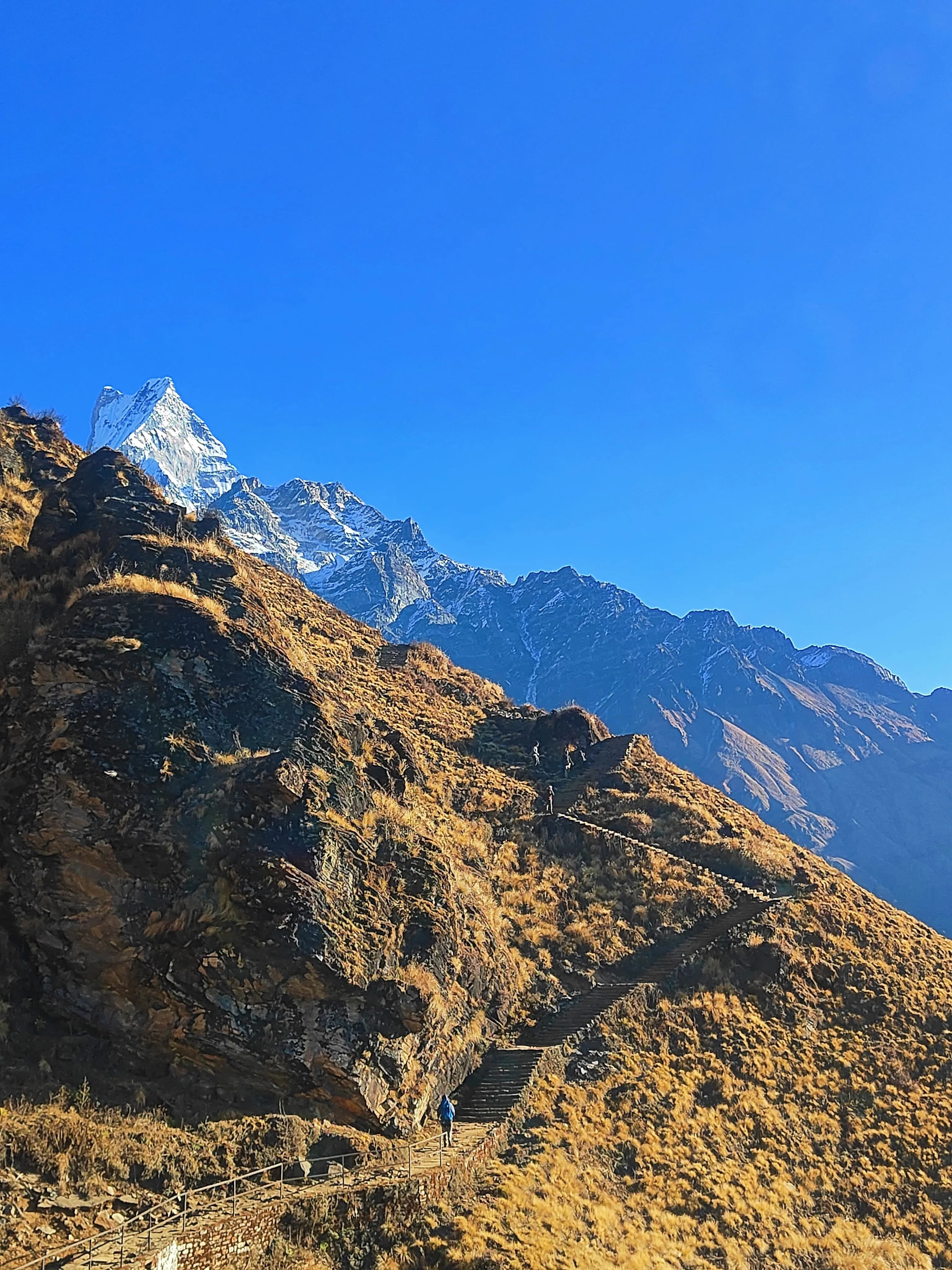
The format only Nepal offers: daily practice combined with a Himalayan trek. Mardi Himal reaches roughly 4,200 m, Poon Hill 3,210 m, with permits, lodging and guide included.
Ayurveda and Sound Healing
Abhyanga massage, Shirodhara, dosha consultation and Tibetan singing bowl sound healing, offered as retreats in their own right or added to a longer stay in Nepal.
Styles of Yoga Taught in Nepal
Most Nepali yoga schools teach classical Hatha yoga as the backbone, and it is what you should expect from a Nepal yoga retreat unless the listing says otherwise. Classical Hatha here means a slower, held practice built on asana, pranayama and relaxation, taught in the traditional yogic sequence rather than as a fitness class. It suits beginners and gives experienced practitioners somewhere to deepen your yoga practice rather than simply sweat.
Beyond that, the common yoga styles you will find are Ashtanga yoga, for practitioners who want a set and demanding series; Vinyasa yoga, a flowing style linking breath to movement; and Yin, held floor postures for connective tissue. We teach Hatha and Ashtanga yoga as the core of our yoga sessions, with Vinyasa yoga and Yin appearing in yoga classes and longer courses.
Almost every programme also carries the non-asana limbs, because that is what separates traditional yoga in Nepal from a studio timetable: pranayama, mantra, yoga philosophy, and meditation twice a day. This is classical yoga in the older sense, where asana is one limb of eight rather than the whole practice. Shatkarma cleansing appears on detox-focused retreats, and karma yoga is part of longer ashram stays.
Yoga Teacher Training in Nepal: What to Expect
Yoga teacher training is the single biggest reason people search for yoga in Nepal, and Nepal yoga teacher training generally costs less than the equivalent in India and considerably less than Bali. A residential 200 hours yoga teacher training here runs three to four weeks, with accommodation and all meals included in the fee rather than added to it.
Course structure is broadly standard across the country. A 100-hour course is the entry point and the usual choice for a first immersion or for a practitioner who cannot take a month off. The 200-hour is the recognised teaching qualification and the one most schools build around. A 300-hour course is the advanced continuation, taken after the 200. Our own yoga training in Nepal is priced at €690, €1,300 and €1,500 respectively, and each is certified yoga teacher training through Yoga Alliance International (USA), so you can register and teach after completing it.
What you actually study is Hatha and Ashtanga yoga asana with alignment and adjustment, pranayama, anatomy and physiology, yoga philosophy, teaching methodology and practicum. Ask any school two things before booking: how many students share the course, and who the yoga teachers actually are. Ours cap at eight and are taught by instructors trained in Indian Himalayan ashrams, including a dedicated yoga and anatomy teacher.
One caveat worth knowing. Yoga teacher certification is not regulated by the Nepali state, and yoga school quality varies widely. A low headline price often means a large group, a rented hall and a rotating cast of yoga teachers, so compare what is included rather than the number alone. Good yoga education and real yoga teaching experience are worth the difference.
Nepal vs India for Yoga
India is yoga's birthplace, home to countless ashrams and gurus. But does that make it the best choice for your yoga journey? Let's compare.
| Factor | India | NepalRecommended |
|---|---|---|
| Mountain Setting | Limited in yoga areas | Direct Himalayan views✓ |
| Ease of Travel | Can be overwhelming | More manageable✓ |
| Visa Process | Advance application needed | Visa on arrival✓ |
| Tourist Infrastructure | Variable quality | Well-developed✓ |
| Yoga Tradition | Birthplace of yoga✓ | Strong Indian influence |
| Cost | Generally affordable | Very affordable✓ |
| Authenticity | Varies widely | Less commercialized✓ |
Mountain Setting
Ease of Travel
Visa Process
Tourist Infrastructure
Yoga Tradition
Cost
Authenticity
Our Verdict
While India offers unmatched tradition and variety, Nepal provides a more manageable, equally authentic experience with unique Himalayan energy. For most practitioners, especially first-timers to Asia, Nepal offers the better overall experience.
Nepal vs Bali for Yoga
Bali has become synonymous with yoga retreats and teacher training. Beautiful, accessible, and Instagram-worthy - but is it authentic? Here's the honest comparison.
| Factor | Bali | NepalRecommended |
|---|---|---|
| Authenticity | Highly commercialized | More genuine✓ |
| Cost | Western prices | Very affordable✓ |
| Spiritual Depth | Surface level | Buddhist-Hindu fusion✓ |
| Setting | Tropical/Beach | Himalayan mountains |
| Yoga Scene | Instagram-focused | Practitioner-focused✓ |
| Party Atmosphere | Prevalent | Minimal✓ |
| Luxury Options | Many available✓ | Limited |
Authenticity
Cost
Spiritual Depth
Setting
Yoga Scene
Party Atmosphere
Luxury Options
Our Verdict
Bali excels at wellness tourism and luxury retreats, but Nepal offers deeper authenticity for serious practitioners. If you want traditional yoga, spiritual depth, and value for money, Nepal wins. If you want beach, Instagram aesthetics, and luxury amenities, choose Bali.
The Nepal Advantage: What You Can't Get Elsewhere
Himalayan Energy
Sacred himalayan mountains visible during yoga practice, and beautiful natural surroundings the whole way. The world's highest peaks create a serene setting you can feel.
True Affordability
Quality yoga programs at a fraction of Bali or Western prices. Your budget goes further without sacrificing authentic yoga.
Buddhist-Hindu Fusion
Birthplace of Buddha meets Hindu tradition. Unique spiritual depth and inner peace unavailable in purely Hindu India or secular Bali.
Less Commercialized
Yoga in Nepal is still about practice, not Instagram. Find genuine seekers, not wellness tourists.
Trekking Combinations
Only Nepal offers a yoga trek. Unique yoga programs combining mountain adventure with yogic practice.
Easy Visa
Visa on arrival for most nationalities. Simple extensions possible. No complex applications required.
Nepal's Unique Spiritual Heritage
Nepal occupies a special place in spiritual geography. This is where the Buddha was born in Lumbini (623 BCE), where Hindu and Buddhist traditions have coexisted for centuries, where tantric Buddhism flourished in medieval Kathmandu. Unlike India's sometimes rigid religious boundaries, Nepal's spirituality blends traditions naturally.
For yoga practitioners, this means access to both Hindu yoga traditions and Buddhist meditation practices. Many Nepal yoga centers incorporate mindfulness techniques from Buddhist traditions alongside classical Hatha yoga. This fusion isn't found in purely Hindu India or secular Bali.
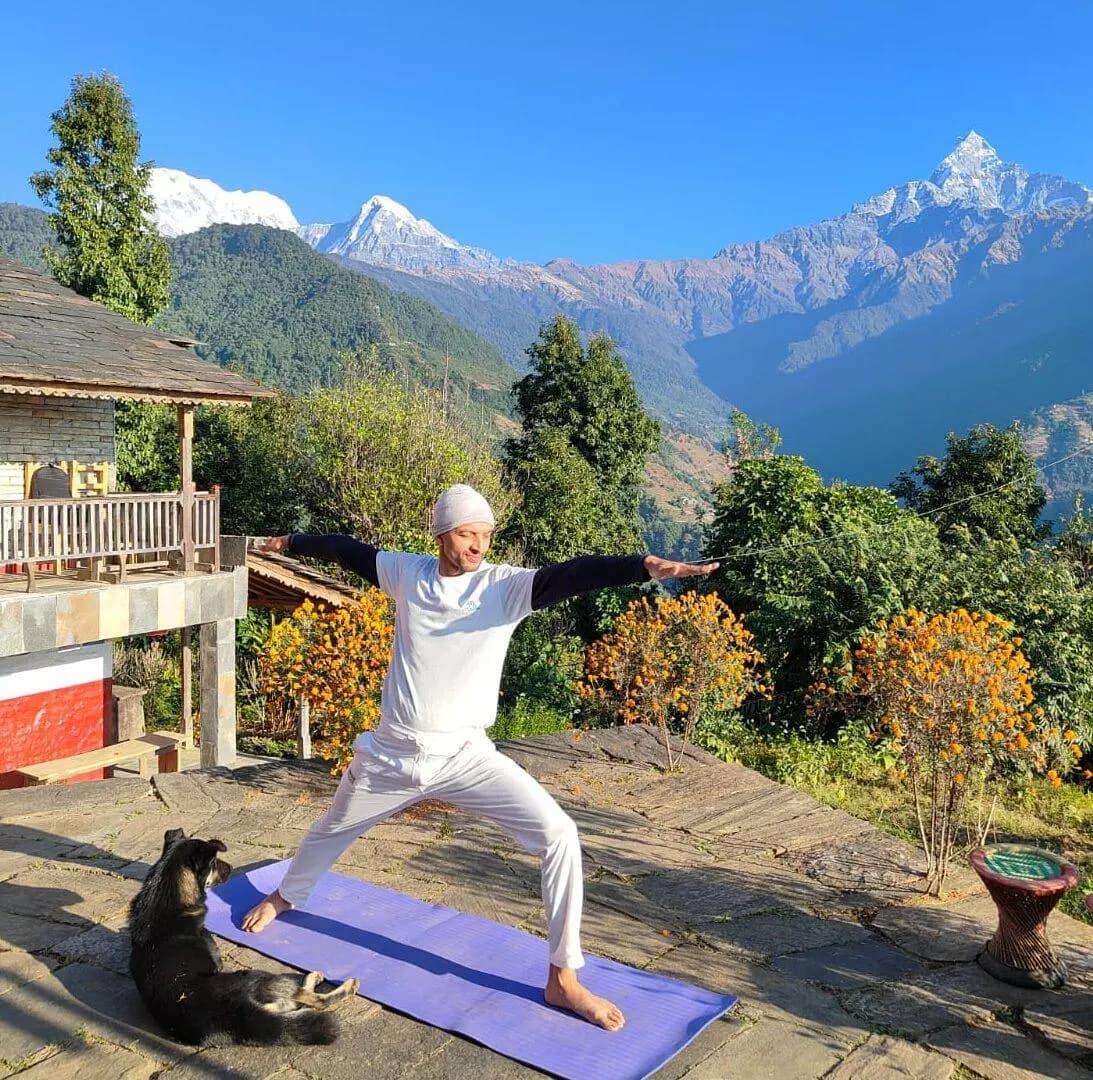
The mountain culture itself shapes the practice. Himalayan peoples have long viewed mountains as sacred abodes of deities, and Machhapuchhre, in full view of our practice space at 6,993 m, is still closed to climbing on religious grounds. Practising with those peaks in front of you connects you to that mountain spirituality, and the environment itself becomes part of the teaching.
Best Time for Yoga in Nepal by Season
Nepal's seasons dramatically affect practice conditions. Here's what to expect:
| Season | Months | Conditions | Best For |
|---|---|---|---|
| Autumn | Oct-Nov | Clear views, mild days, cool nights | Best overall - peak season |
| Spring | Mar-May | Warm days, blooming rhododendrons | Second best - some haze |
| Winter | Dec-Feb | Cold mornings, clear skies, fewer tourists | Serious practitioners only |
| Monsoon | Jun-Sep | Rain, clouds, humidity, leeches | Indoor practice only |
Nepal Yoga by the Numbers
Eight of the world's fourteen, including Everest (8,849m)
UNESCO World Heritage Site in southern Nepal
15, 30 or 90 day tourist visa, no advance application
3 days full board at our ashram above Pokhara
100-hour course; 200-hour is €1,300
Where to Practise: Kathmandu Valley or Pokhara
Nepal has two centres of practice and they are not interchangeable. The Kathmandu Valley has the greater number of yoga schools, the international airport, and the Buddhist sites at Boudhanath and Swayambhunath. It is also congested, and its winter air quality is among the worst in Asia, which matters more than people expect when a yoga class opens with twenty minutes of pranayama. Two or three days in Kathmandu at either end of a trip is the pattern most visitors settle on, and yoga teacher training in Kathmandu is widely available if the city suits you.
Pokhara, six hours west by road or 25 minutes by air, is where most people actually stay in Nepal to practise. It sits at 827 m beside Phewa Lake with the Annapurna range directly north, air quality runs roughly a quarter of Kathmandu's pollution levels, and it is the trailhead for every yoga trek. If you are choosing one base for a yoga holiday, choose Pokhara.
Our own yoga school is a further 30 minutes above Lakeside in Ghachowk, a Gurung farming village at around 1,100 m. The trade is deliberate: you give up cafes and nightlife and get a genuinely peaceful environment, unobstructed Annapurna views from the practice space, and food mostly grown on the farm below it. For a week yoga retreat or a month-long course, that quiet is the point rather than a compromise.
Is a Yoga Retreat in Nepal Right for You?
If this would be your first yoga holiday abroad, Nepal is a forgiving place to learn yoga. Groups are small, everything is taught in English, and nobody expects you to arrive flexible. A first yoga retreat here usually means a week of two daily sessions, and what the retreat provides beyond the mat - full board, a fixed rhythm, no decisions to make - is most of why people describe the experience of yoga in Nepal as transformative rather than merely restful.
For practitioners already holding a regular practice, the draw is different. Deepening your practice needs time and quiet more than novelty, and a month in an ashram at 1,100 m gives both. Nepal offers quality yoga teaching at a price that makes a long stay realistic, which is why a good number of people who come for a week come back for a course. Yoga meditation sessions morning and evening do more for a stalled practice than another workshop.
Nepal is a poor fit if you want beach, nightlife or a luxury spa resort, and it is a poor fit in monsoon. Be honest with yourself about which of those matters, because the best experience of Nepal comes from choosing the season and the setting deliberately rather than arriving and hoping.
Planning a Yoga Trip to Nepal
Most people visit Nepal for yoga on a two to four week trip. A three-day retreat works as an add-on to a trekking holiday; a week is the standard for a first proper retreat; and three to four weeks is what a 200-hour course or a long ashram stay requires. Book the retreat or teacher training first and fit flights around it, because course dates are fixed and retreat dates usually are not.
Practicalities are simple by Asian standards. A tourist visa is issued on arrival at Kathmandu airport for 15, 30 or 90 days at USD 30, 50 and 125. Everything is taught in English. Bring layers for cool mountain mornings even in warm months, modest clothing for villages and temples, and a refillable water bottle. You do not need to bring a mat.
Two honest cautions. Monsoon runs June to September and the mountains largely disappear behind cloud, so if the Himalayan views are the reason you are coming, aim for October and November or March to May. And confirm exactly what a quoted price includes, since some schools list tuition only while others, ours included, quote one figure covering room, all meals and every session.
Common Questions About Yoga in Nepal
Written by
Swami AnandaSwami Ananda is the founder of Yoga in Pokhara, with over 10 years of teaching experience. Trained at ashrams in the Himalayas, he brings authentic yoga traditions to Pokhara, Nepal.
Experience Yoga in Nepal
Join us in Pokhara for authentic yoga practice with Himalayan mountain views, clean air, and Indian Himalayas Ashram trained instruction.